Heyy... are you really leaving without your FREE eBook!?!

Come on... drop your email in the box below and get that eBook ASAP to learn
27 ways to improve your health with Liquid Coconut!
No worries, you’ll get only the real good stuff from us.
Get your eBook FREE of charge below!

Types of Micronutrients: Essential Vitamins and Minerals
Wednesday, November 05, 2025
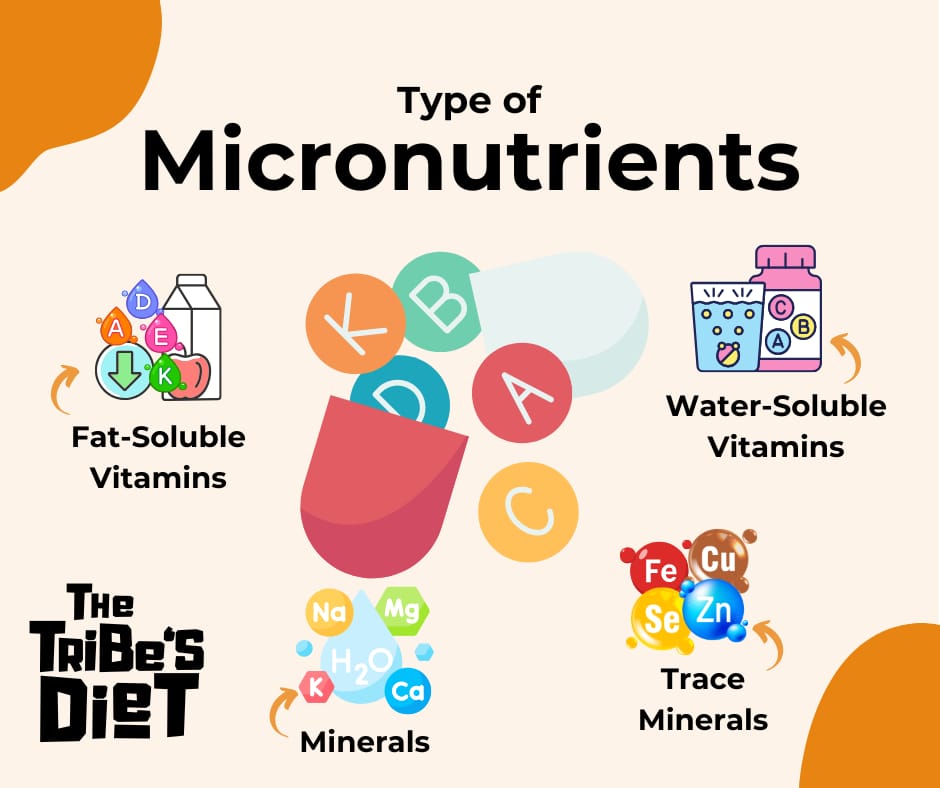
Types of Micronutrients: Essential Vitamins and Minerals
Micronutrients may be needed in tiny amounts, but their impact on your health is enormous. From energy metabolism to immune defense, bone strength, and cellular repair, understanding the types of micronutrients and their functions is essential for optimal health.
Micronutrients are nutrients required in small amounts (milligrams or micrograms) that are critical for human health. Despite their small quantity, deficiencies or imbalances can lead to severe health issues. Micronutrients are broadly divided into vitamins and minerals, each with specific types, functions, and sources.
Vitamins: The Organic Micronutrients
Vitamins are organic compounds that the body cannot synthesize in sufficient amounts and must be obtained from diet. They are vital for metabolism, cellular function, immunity, and tissue repair. Vitamins are classified as fat-soluble or water-soluble based on how the body absorbs, stores, and excretes them.
1. Fat-Soluble Vitamins
Fat-soluble vitamins dissolve in fats and are stored in liver and fatty tissues, making them less likely to need daily intake but more susceptible to toxicity if overconsumed.
- Vitamin A (Retinol, Beta-Carotene): Supports vision, immune function, and epithelial tissue integrity. Sources include liver, carrots, sweet potatoes, and leafy greens. Deficiency can cause night blindness, impaired immunity, and skin issues.
- Vitamin D: Regulates calcium and phosphorus absorption, maintaining bone density and immune function. Sun exposure, fatty fish, egg yolks, and fortified foods are key sources. Deficiency can lead to rickets in children and osteoporosis in adults.
- Vitamin E (Tocopherols and Tocotrienols): A potent antioxidant protecting cell membranes from oxidative stress. Found in nuts, seeds, and vegetable oils. Deficiency is rare but can cause neurological problems.
- Vitamin K (K1 and K2): Essential for blood clotting and bone metabolism. Leafy greens, broccoli, and fermented foods provide vitamin K. Deficiency can lead to excessive bleeding and weakened bones.
2. Water-Soluble Vitamins
Water-soluble vitamins are not stored in the body in significant amounts and must be consumed regularly. Excess is generally excreted in urine, reducing the risk of toxicity.
- Vitamin C (Ascorbic Acid): Crucial for collagen synthesis, antioxidant defense, and immune support. Found in citrus fruits, berries, and peppers. Deficiency leads to scurvy, characterized by gum bleeding, fatigue, and slow wound healing.
- B Vitamins: Includes B1 (thiamine), B2 (riboflavin), B3 (niacin), B5 (pantothenic acid), B6 (pyridoxine), B7 (biotin), B9 (folate), and B12 (cobalamin). These vitamins play critical roles in energy metabolism, red blood cell production, neurological function, and DNA synthesis. Sources include whole grains, meats, dairy, leafy vegetables, legumes, and fortified foods. Deficiencies can cause anemia, fatigue, neurological symptoms, or developmental issues in infants.
Minerals: The Inorganic Micronutrients
Minerals are inorganic elements that support structural, regulatory, and enzymatic functions in the body. Minerals are categorized into major minerals (macrominerals) and trace minerals (microminerals) based on daily requirements.
1. Major Minerals
Major minerals are required in larger amounts (100 mg or more per day) and support structural and physiological processes.
- Calcium: Builds and maintains bones and teeth, supports muscle contraction, nerve signaling, and blood clotting. Found in dairy, fortified plant milks, leafy greens, and tofu. Deficiency can cause osteoporosis, rickets, or muscle cramps.
- Magnesium: Supports enzyme activity, muscle and nerve function, blood pressure regulation, and bone health. Found in nuts, seeds, whole grains, and green vegetables. Deficiency may result in muscle cramps, fatigue, or irregular heart rhythm.
- Potassium: Maintains fluid balance, nerve transmission, and heart function. Sources include bananas, potatoes, beans, and leafy greens. Deficiency can cause weakness, cramping, and arrhythmias.
- Sodium: Regulates fluid balance and nerve impulses. While essential, excess sodium can contribute to hypertension and cardiovascular disease.
- Phosphorus: Combines with calcium to strengthen bones and teeth and participates in energy metabolism (ATP). Found in meat, dairy, legumes, and nuts.
2. Trace Minerals
Trace minerals are required in very small amounts but are equally essential for health.
- Iron: Critical for oxygen transport and energy metabolism. Found in red meat, beans, lentils, and leafy greens. Deficiency leads to anemia, fatigue, and impaired cognitive function.
- Zinc: Supports immune function, wound healing, DNA synthesis, and growth. Found in meat, shellfish, legumes, and seeds. Deficiency can impair immunity and delay wound healing.
- Iodine: Necessary for thyroid hormone synthesis, regulating metabolism. Found in iodized salt, seafood, and dairy. Deficiency can cause goiter and hypothyroidism.
- Selenium: Antioxidant supporting thyroid health and immune function. Found in nuts, seafood, and meat. Deficiency may contribute to weakened immunity and heart issues.
- Copper, Manganese, Chromium, Molybdenum, Fluoride: Involved in enzyme function, bone formation, antioxidant defense, and glucose metabolism. Though needed in tiny amounts, deficiencies can disrupt metabolic processes.
Importance of Micronutrient Balance
Even small deficiencies can have serious health consequences, including fatigue, anemia, bone disorders, immune dysfunction, and cognitive decline. Conversely, overconsumption, particularly through supplements, can lead to toxicity, especially for fat-soluble vitamins (A, D, E, K) and trace minerals like iron and selenium.
Ensuring a balanced intake through diet is the safest approach. Whole, minimally processed foods provide micronutrients in combination with other beneficial compounds such as fiber and phytonutrients, optimizing absorption and health benefits.
How to Ensure Adequate Micronutrient Intake
1- Consume a varied diet: Include colorful fruits and vegetables, lean proteins, whole grains, nuts, seeds, and dairy or fortified alternatives.
2- Focus on nutrient-dense foods: Prioritize foods rich in vitamins and minerals relative to calories.
3- Consider supplementation if necessary: For example, vitamin D in low-sunlight regions, B12 for vegans, or iron for menstruating women.
4- Monitor intake: Avoid excessive supplementation without medical supervision to prevent toxicity.
Bottom Line
Micronutrients, though required in small amounts, are vital for every function in the body. Vitamins regulate metabolism, immunity, and tissue repair, while minerals provide structural support, enzyme function, and fluid balance. A diet rich in whole, nutrient-dense foods ensures adequate intake, supports optimal health, prevents deficiencies, and maintains long-term wellness.
If you would like to learn more about the Tribe's Diet, how you can adhere to it, and what benefits it could bring you, be sure to follow us on your favorite social media or sign up for our Coco-Nuts Tribe Newsletter just down below.
Don’t forget that, by joining our Coco-Nuts Tribe Newsletter, you will receive my new FREE eBook – 27 Ways to Improve Your Health with Liquid Coconut.
I hope you enjoy it and talk to you next time!
Lenny Gee

Hi, I Am Lenny Gee
Co-Founder of Coco-Nuts.life
My love for nutrition and my passion for coconuts gave me this crazy idea to start this tropical adventure where we want to help you achieve wellness and enjoy life the way it should be.
FREE eBook
27 Ways To Improve Your Health With Liquid Coconut
Subscribe to our Tribe and receive our eBook FREE of cost.
Packed with useful recipes to guide you, and healthy benefits to inform you, this eBook makes it easier than ever for you to use our Liquid Coconut - totally FREE of charge.
Coco
-Nuts
Coco
-Nuts
Health ● Mind ● Body
Health ● Mind ● Body
Quick Links
© 2025 Coco-Nuts inc., ALL RIGHTS RESERVED
†These statement have not been evaluated by the Food & Drug Administration. This product do not intended to diagnose, treat, cure, or prevent any disease.
Information provided by this website or this company is not a substitute for individual medical advice.